
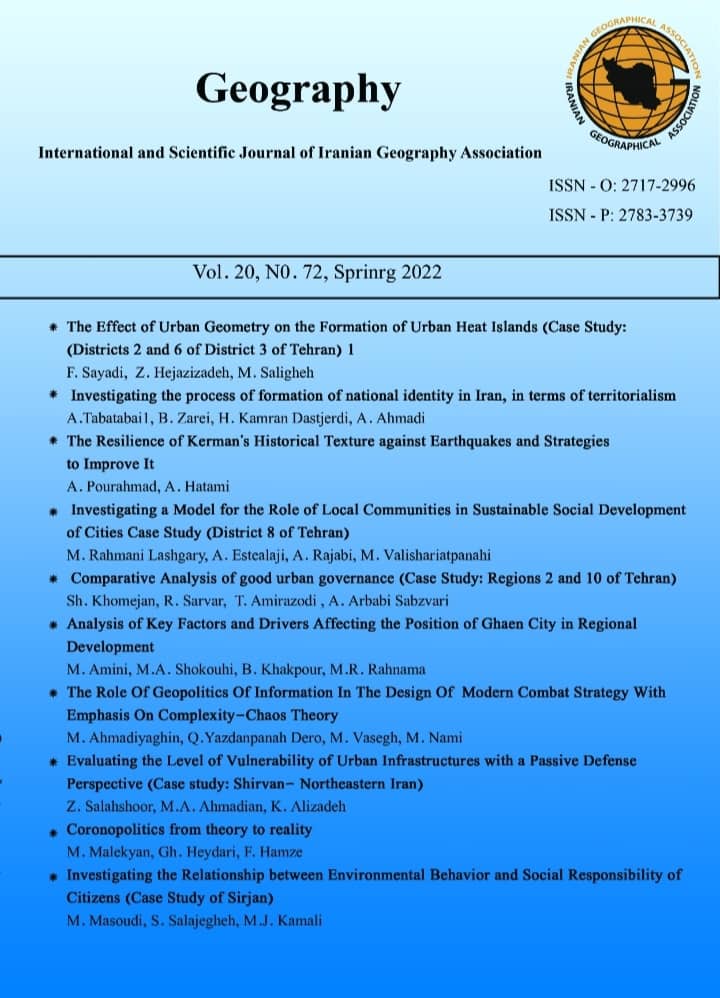
Geography (Journal of the Iranian Geographical association) (JIGA) is an open-access peer-reviewed quarterly journal in Persian (with English abstracts and bibliographies), disseminates significant research in the mutual relations between man and the environment. This journal is one of the essential journals in the science of geography in Iran and is supported by the Iranian Geographical Association. It is an interdisciplinary journal devoted to the publication of original articles, review articles, etc., considering the research ethics and academic rules and regulations.
###############################################################################################################################
About the Journal
Journal Title: Geography
Standard Abbreviation: (JIGA)
Country of Publication: Iran, Tehran
Publisher: Iranian Geographical Association
Scientific Sponsorship Society: Iranian Geographical Association
Subject Area: Political geography, Urban geography, Rural geography, Climate, Geomorphology, Tourism
Format: Print and Online
Print ISSN: 2783-3739
Online ISSN: 2717-2996
Frequency: Quarterly
Journal language: Persian, including English abstracts and bibliographies.
Access: Free and free download of articles ( )
)
Article types: Research and review papers.
Primary Review: 10 days, approximately.
Peer Review Policy: Double-anonymous peer-review
Average refereeing time: 12 weeks
Acceptance percentage: 20%
Submission Charges: No
Article Processing Charges: Yes
Citation Style: The APA referencing style
Website: https://mag.iga.ir/
E-mail: journalogeo@gmail.com
Tel: +98-21-66913946
Indexing & Abstracting: EBSCO, ISC, SID, Noormags, Magiran, Iran Journals, Google Scholar, Academia, LinkedIn, etc.
COPE: Journal of the Iranian Geographical association follows the policies and guidelines of the Committee on Publication Ethics (COPE) and abides by its Code of Conduct in dealing with potential cases of misconduct.
Copyright & License: Creative Commons — Attribution-NonCommercial 4.0 International.The copyright of articles belongs to the authors, and the authors own and hold the copyright to their work (CC BY-NC 4.0). Authors retain unrestricted copyrights and publishing rights.
Required files to be uploaded: Five essential files must be submitted through the manuscript submission system: 1. The main file of the manuscript (without the names of the authors), 2. Title page in the mentioned format, 3. Authorship form (must include the title of the article and the name and surname of all authors and be signed by all authors), 4. Conflicts of Interest form (must be signed by the Corresponding Author and uploaded with the article file), and 5. Cover letter.
Address: Iran,Tehran, Azadi St., North Eskandari St., Shabahang Intersection, East Tous St., No. 83, 4th Floor.
Important notice
We request all respected authors to send their articles only through the journal system and their personal pages and to follow up only through this method, and to absolutely refrain from delivering or sending articles to the email of any natural or legal person and making phone calls in this regard. Because the journal office will not be responsible for the articles that are sent except through the journal system. Geography magazine uses software similar to Yaab in order to protect the rights and intellectual and intellectual property of researchers and authors of scientific articles and to prevent duplicate research from being received.
Respected authors can use the Samimnoor system (click) to send a matching report to the quarterly journal. Respected authors should be careful that they must send the PDF report of similarity that they receive directly from similarity finder to the quarterly.
Pages 1-23
10.22034/jiga.2026.2085018.1482
Somayeh Azizi, Farhad Azizpour, Vahid Riahi
Pages 23-43
10.22034/jiga.2026.2089269.1490
ALi shamai, Alireza Dehzadegan
Pages 45-59
10.22034/jiga.2026.2069019.1433
Hosein Mojtabazade, Hosein Rezaei, Leila Abedifard
Pages 61-78
10.22034/jiga.2026.2089962.1493
Ayyoub Amani, vakil heidari Sareban, Arastoo Yari Hesar, bahram imani
Pages 79-103
10.22034/jiga.2026.2076947.1459
Ghorban Jafari, Abdolreza Kashki
Pages 117-135
10.22034/jiga.2026.2084974.1481
Bromand Salahi, Ali Shahi
Pages 137-161
10.22034/jiga.2026.2063357.1415
farzad hafezmoghadam, sedigheh hasanimehr, Rafat Shahmari Ardjani, Alireza Pourshikhian
Pages 151-168
10.22034/jiga.2026.2078439.1464
Mohammad Mehdi Mohammadi, Abbas Arghan, Mohammad Reza Zandemghaddam


